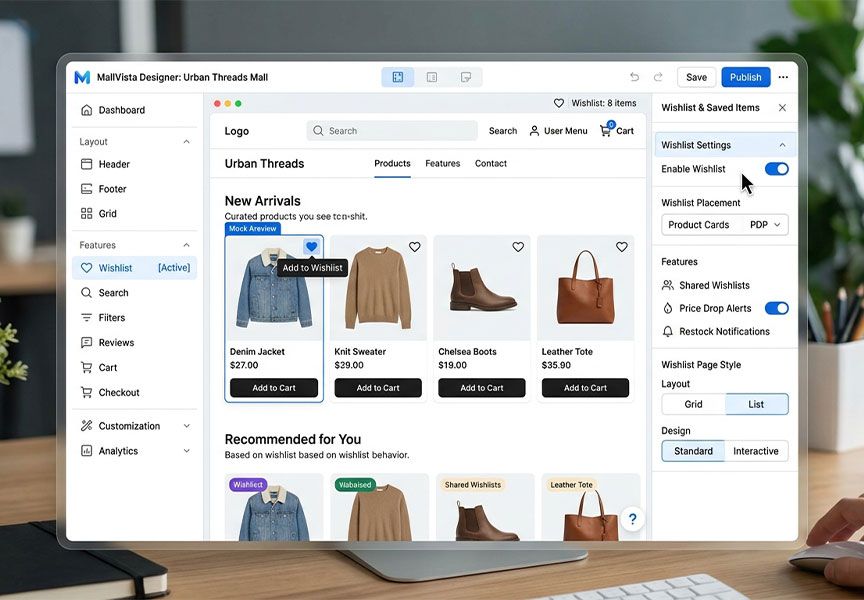
Cafe24 is a managed commerce platform: hosting, payments, and marketplace integrations are included, and you operate inside its system. WooCommerce is a self-hosted store built on WordPress: you own the stack, the data, and the maintenance burden. Neither is universally better — they optimize for different constraints.
The short version: choose Cafe24 when speed to market, built-in Korean payment and marketplace integrations, and low operational overhead matter most. Choose WooCommerce when you need full control over content, markup, performance, and international selling — and you are prepared to maintain the stack.
This guide compares the two across the dimensions that actually decide the outcome: cost structure, SEO control, global selling, and long-term operational load.
Two Different Models, Not Two Products
The comparison is often framed as a feature checklist. That framing misses the point. The real difference is who owns the infrastructure:
- Cafe24 — managed platform. The platform provides hosting, commerce features, payment gateways, and marketplace connections. You configure and design within it. Upgrades, scaling, and infrastructure security are the platform's responsibility.
- WooCommerce — self-hosted stack. WordPress and WooCommerce are software you install and run. You choose the host, the caching layer, the plugin set, and the update policy. Every capability is available, and every capability is your responsibility.
That single difference cascades into cost, control, and risk.
What Cafe24 Does Well
Cafe24 is the most widely used commerce solution in the Korean market, and its strengths are structural rather than cosmetic:
| Strength | Why it matters |
|---|---|
| Hosting included | Infrastructure cost and scaling are handled by the platform, which lowers the upfront burden |
| Built-in commerce features | Product management, orders and payments, membership tiers, loyalty points, coupons, and promotions ship as standard |
| Payment gateway integration | Korean payment methods such as KakaoPay, NaverPay, and Toss connect with minimal setup |
| Marketplace integration | Connections to Naver Smart Store, Coupang, and 11st let one catalog reach multiple sales channels |
| Multilingual and multi-currency | Global selling is supported without building a separate storefront |
| App ecosystem | Additional functionality is available through the Cafe24 app store |
| Custom skin support | The default template can be replaced with a fully custom, responsive design |
The practical advantage is time. A store can be transacting in days rather than weeks, and the operational surface you must maintain yourself is small.
What WooCommerce Does Well
WooCommerce trades convenience for control. What that buys you:
- Full ownership of the stack. The database, the content, and the URL structure are yours. There is no platform migration to negotiate if you outgrow the setup.
- An open plugin ecosystem. Payments, subscriptions, shipping logic, tax rules, and B2B pricing are all extensible — including custom development when no plugin fits.
- Global payment flexibility. International gateways, multi-currency pricing, and region-specific tax handling are configurable rather than constrained by a platform's supported list.
- Content and commerce in one system. Editorial content, landing pages, and product pages live in the same WordPress installation, which is a significant advantage for organic acquisition.
- Complete control over markup and performance. Structured data, semantic HTML, caching strategy, and Core Web Vitals are all yours to engineer.
The cost of that control is maintenance: core updates, plugin compatibility, backups, and security monitoring are ongoing work, not a subscription line item.
Side-by-Side Comparison
| Dimension | Cafe24 | WooCommerce |
|---|---|---|
| Model | Managed platform | Self-hosted on WordPress |
| Hosting | Included | Chosen and managed by you |
| Korean payment methods | Built in | Via plugins and gateway accounts |
| Marketplace integration | Native | Via plugins or custom integration |
| Design control | Custom skin within platform constraints | Unrestricted |
| SEO control | Strong, within platform structure | Complete control over markup and URLs |
| Performance tuning | Limited to platform options | Full control over caching and assets |
| Maintenance load | Low | Ongoing |
| Data ownership | Platform-hosted | Fully yours |
| Best for | Fast launch, Korean market focus | Control, content-led growth, global selling |
Which One Fits Your Business?
Choose Cafe24 when…
- You need to be selling quickly and the catalog is straightforward.
- Your customers are primarily in Korea and pay with Korean payment methods.
- You want to list on Korean marketplaces without building integrations.
- You prefer to spend budget on design and merchandising rather than infrastructure.
Choose WooCommerce when…
- Organic content is a primary acquisition channel and you want content and commerce in one system.
- You need custom pricing, subscription, or fulfillment logic that a platform cannot express.
- You sell internationally and need control over currency, tax, and payment routing.
- You want to own the data and the URL structure outright.
Consider both when…
- You are launching in Korea first and expanding internationally later. A Cafe24 storefront can validate demand quickly; a WooCommerce build can follow once the catalog and content strategy are proven.
SEO and AI Search: Where the Platforms Differ
Both platforms can rank well. The difference is how much of the outcome you control.
On Cafe24, the levers are configuration and content: product schema markup, per-category titles and descriptions, image optimization with descriptive alt text and modern formats, XML sitemaps, and marketplace product feeds. The platform handles the technical foundation; your work is in the content layer.
On WooCommerce, every layer is available: semantic markup, structured data, URL architecture, internal linking, caching, and Core Web Vitals budgets. That is more power and more ways to get it wrong.
For AI search specifically, the same structural discipline applies on both platforms — a self-contained answer near the top of the page, question-shaped headings, explicit specifications, and visible freshness dates. Product pages that state price, availability, and compatibility plainly are easier for answer engines to cite than pages that bury the same facts in marketing copy. Our AEO service and GEO consulting cover this in depth.
Cost Structure: What You Actually Pay For
The two models distribute cost differently, which makes headline comparisons misleading:
- Cafe24 concentrates cost into platform subscription tiers and app purchases. Infrastructure, scaling, and platform security are included. Your variable cost is design and merchandising work.
- WooCommerce has no license fee for the software itself, but you pay for hosting sized to your traffic, ongoing maintenance, and the engineering time to keep the stack current. Your variable cost is operational time.
The honest comparison is total cost of ownership over two to three years, including the hours your team spends on updates and troubleshooting — not the monthly line item alone.
Frequently Asked Questions
Can I migrate from Cafe24 to WooCommerce later?
Yes, but plan for it. Product data, orders, and customer records can be exported and transformed, while design and URL structure generally need to be rebuilt. Preserving URL paths or setting up redirects is essential to avoid losing accumulated search visibility.
Is WooCommerce fast enough for a large catalog?
It can be, with the right architecture: a host with adequate resources, a layered cache that bypasses cart and checkout, correctly sized images, and a disciplined plugin set. Performance problems in WooCommerce are usually architectural rather than inherent to the platform.
Does Cafe24 support international customers?
Yes. Multilingual and multi-currency support allows a single storefront to serve customers outside Korea, which is often enough for an initial international test.
Which platform is better for SEO?
WooCommerce offers more control, which means a higher ceiling and a lower floor. Cafe24 provides a solid technical foundation with less room to misconfigure — and less room to optimize beyond the platform's options.
Where to Start
The platform decision should follow the business model, not precede it. Define where your customers come from, how they pay, and how much operational capacity you have — then choose the platform that fits those answers.
SowonWeb builds both Cafe24 storefronts and WordPress/WooCommerce sites, and is registered in the Cafe24 Design Center. Explore our Cafe24 production service and WordPress production service, review pricing, or get in touch to talk through your requirements.